
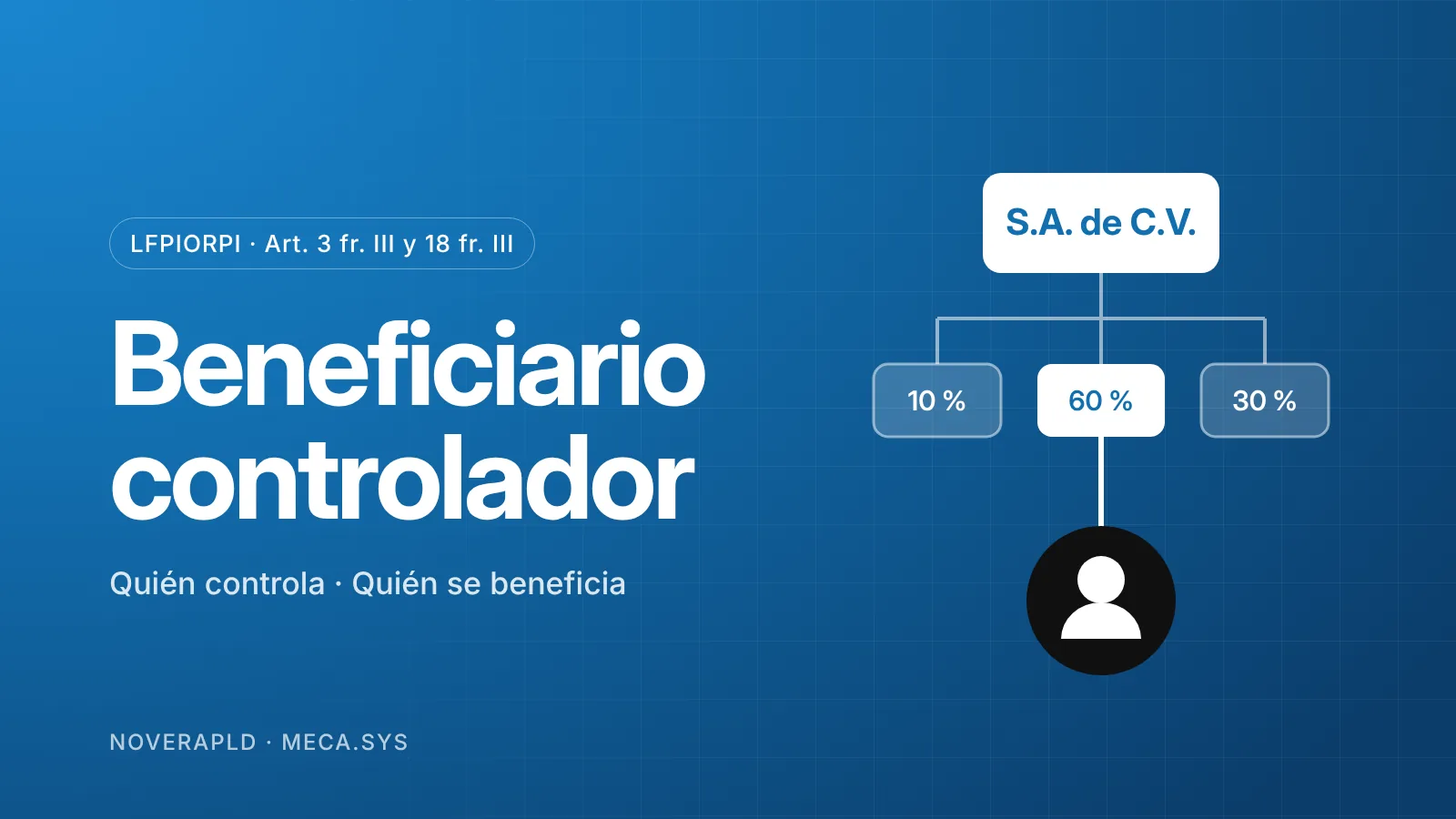
Do you know who is really behind a company, or who receives the final benefit of a real estate transaction? That is one of the questions answered by the figure of the beneficial owner (beneficiario controlador), a key concept for companies that carry out Vulnerable Activities under Mexico's Federal Law for the Prevention and Identification of Transactions with Resources of Illicit Origin (LFPIORPI).
Correctly identifying the beneficial owner makes it possible to know who obtains the effective benefit of a transaction or who exercises real control over a legal entity, even when there are intermediaries or corporate structures.
For real estate agencies, developers, land developers and other reporting entities, understanding this figure matters for building client files, knowing their customers and meeting their anti-money laundering obligations.
In this article we explain what a beneficial owner is, how to identify one, and in which situations it must be considered in LFPIORPI compliance processes. If you first need an overview of the law, read our guide on what the LFPIORPI is and who it applies to.
What is a beneficial owner?
Under Article 3, Section III of the LFPIORPI, the beneficial owner is the individual or group of individuals who ultimately obtain the benefit of use, enjoyment, exploitation or disposal of a good or service resulting from a transaction with someone who carries out a Vulnerable Activity, or who exercise effective control over a legal entity that takes part as a client or user.
Put simply, it means identifying the individual who actually benefits from a transaction or who exercises effective control over a company, even if they do not appear as the person directly carrying out the transaction.
For example, a company may sign a contract to buy a property. Even though the transaction is made in the name of the legal entity, it may be necessary to identify the individuals who exercise effective control over it.
This identification helps prevent corporate structures from hiding who really controls an entity or who obtains the benefit of certain transactions.
The LFPIORPI treats this figure as equivalent to the concepts of ultimate beneficiary and real owner for the purposes of the law and other applicable provisions.
How do you determine who the beneficial owner is?
It is not always enough to check who appears as legal representative or who signs a contract. You need to analyze who obtains the final benefit of the transaction and, where applicable, who exercises effective control over the legal entity.
The legislation includes, among others, the following criteria for determining effective control over a legal entity:
- Shareholding or voting rights: a person may exercise control when they hold, directly or indirectly, rights to vote more than 25% of the share capital.
- Decision-making powers: they may control decisions at shareholders' or partners' meetings, or have the power to appoint or remove the majority of the management body.
- Control of management: they may direct, directly or indirectly, the company's management, strategy or main policies.
- Effective benefit of a transaction: a person may be the one who ultimately obtains the benefit of a transaction, even if someone else formally takes part in it.
These criteria must be analyzed under the legal definition and the applicable General Rules. Shareholding is not the only factor to consider.
Practical example
A real estate developer signs a contract to sell a plot of land to a company set up as a legal entity.
The buying company has several shareholders, but one individual indirectly holds a stake that allows them to exercise effective control over the company's decisions.
In this case, identifying only the buyer's legal representative does not necessarily reveal who exercises effective control.
The company carrying out the Vulnerable Activity must apply the corresponding identification procedures to determine who the beneficial owner is, gather the required information and keep records supporting that identification.
When must you identify the beneficial owner?
Identifying the beneficial owner is part of the obligations set out in Article 18, Section III of the LFPIORPI for those who carry out Vulnerable Activities, under the applicable scenarios.
Specific obligations depend on the characteristics of the client or user and of the transaction.
When your client is a legal entity
If the client is a company or other legal entity, you must obtain the documents or other officially recognized means of identification that allow you to identify its beneficial owner, under the applicable General Rules.
This means the company should not limit itself to collecting the legal representative's documents. It must also follow the corresponding procedure to identify the individual who ultimately obtains the benefit or exercises effective control.
When your client is a trust or other legal arrangement
The provisions also require identifying the beneficial owner when the client or user is a trust or other legal arrangement.
In these cases, it may be necessary to analyze who has effective powers to manage or direct the assets, decide what happens to them or exercise other relevant powers.
Identification must follow the specific rules that apply to each legal arrangement.
When your client is an individual
When the client or user is an individual, the provisions require obtaining a statement on whether they are aware of the existence of a beneficial owner and, where applicable, the available documentation to identify them.
So the procedure is not simply to assume that the client is necessarily the ultimate beneficiary: the question must be asked and documented according to the applicable requirements.
Before the transaction or when establishing a business relationship
The General Rules provide that the beneficial owner must be identified before carrying out the act or transaction or, at the latest, when establishing the business relationship, as applicable.
The procedure followed must also be documented, and the supporting information and documents kept and updated for the duration of the business relationship, under the applicable provisions.
That is why it makes sense to build beneficial owner identification into your regular client onboarding and file preparation process, rather than leaving it for a later review.
What information should you gather to identify the beneficial owner?
The specific documentation depends on the characteristics of the client, the transaction and the applicable rules.
In general terms, the process may involve:
- Asking about the existence of a beneficial owner.
- Gathering the required identification data.
- Obtaining the documents or means of identification set out in the applicable provisions.
- Analyzing the ownership and control structure where applicable.
- Documenting the procedure used to identify them.
- Keeping the information and documents that support the identification.
- Keeping records up to date during the business relationship, under the applicable obligations.
It is important to use the official forms and instructions in force and to check which information applies to the type of client and to the company's activity.
You can consult guidance materials and forms on the SAT Anti-Money Laundering Portal.
How does the beneficial owner relate to real estate?
Identifying the beneficial owner is especially relevant in certain real estate transactions because legal entities, business groups, representatives, investors and other legal structures may be involved.
For example, a real estate agency may broker the sale of a plot of land whose buyer is a company. A developer may receive funds for a real estate project, or a company may take part in a transaction through a corporate structure.
When these transactions fall within the scenarios of the LFPIORPI, the reporting entity must apply the corresponding identification procedures.
Situations that deserve special attention include:
- Property sales: when legal entities or legal structures are involved, it is important to determine who obtains the final benefit or exercises effective control, as applicable.
- Real estate development: developers that receive funds for projects covered by the law must consider the identification obligations that apply to their clients or users.
- Land sold in installments: when a company sells lots through partial payments, it is important to keep client data, contracts and transaction records organized, and to apply the beneficial owner identification procedure where applicable.
- Property leasing: those carrying out leasing activities covered by the LFPIORPI must review the identification requirements that apply to them.
In all these cases, the specific obligation must be determined based on the activity, the characteristics of the transaction and the regulations in force. Not all real estate transactions trigger the same obligations.
For the rest of the sector's obligations, read our guide on the LFPIORPI in the real estate sector.
Common mistakes when identifying the beneficial owner
Incorrect or incomplete identification can make it harder to build client files and follow up on compliance obligations.
Some mistakes to avoid:
Confusing the legal representative with the beneficial owner
The legal representative acts on behalf of a legal entity, but that does not necessarily mean they exercise effective control or receive the final benefit of the transaction.
Reviewing only the direct shareholder
In some corporate structures, control can be exercised indirectly. Where applicable, you need to analyze the ownership and control structure until you identify the relevant individual.
Not documenting the identification procedure
Besides obtaining information, it is important to keep records and documents that show how the identification was carried out.
Not updating information
Shareholding, management powers and other circumstances can change. Keeping information up to date during the business relationship helps maintain consistent client files.
Using scattered records
When information is spread across paper documents, emails and spreadsheets, consulting the data and checking that a file is complete can become more difficult.
A uniform procedure and document management tools can make these tasks easier.
How can you make beneficial owner control easier?
For companies that carry out Vulnerable Activities, the challenge is not only identifying the beneficial owner. They also need to organize the data, keep the documentation and have client files available for consultation.
Orderly management may include:
- Building beneficial owner identification into the client onboarding process.
- Using checklists to confirm that the required information was gathered.
- Linking documents to the client file and the corresponding transactions.
- Documenting the identification procedure.
- Setting up follow-up and update mechanisms for client files.
- Assigning internal owners to review information and handle pending tasks.
For companies with a large volume of clients, contracts and transactions, managing these processes manually can increase the workload and make follow-up harder.
That is why a specialized tool, such as LFPIORPI compliance software, can help centralize information and maintain better administrative control.
Conclusion
Identifying the beneficial owner is an important part of anti-money laundering obligations for those who carry out Vulnerable Activities.
Understanding who obtains the effective benefit of a transaction or who controls a legal entity makes it possible to build more complete client files and better-documented identification processes.
For real estate agencies, developers, land developers and other companies subject to the LFPIORPI, clear procedures and tools that make information easier to manage can simplify the follow-up of these responsibilities.
NoveraPLD: organize your client and beneficial owner information
NoveraPLD is Meca.sys software designed to support companies that carry out Vulnerable Activities in organizing and tracking different processes related to the LFPIORPI.
The platform includes tools to manage client files, record client information, organize beneficial owner data and manage documentation associated with transactions and compliance obligations.
By centralizing this information, companies can make client files easier to consult and rely less on scattered records.
NoveraPLD also offers tools for contracts and transactions, risk assessment, controls and policies, and management of compliance-related documents.
These features can help structure internal processes and follow up on the information needed, according to each company's obligations.
Keep in mind that using software does not replace reviewing the regulations in force, nor does it guarantee legal compliance on its own. The company remains responsible for correctly applying the obligations that correspond to it.
Does your company carry out Vulnerable Activities and need better-organized client files?
Learn about NoveraPLD, Meca.sys software for managing client files and beneficial owners, and see how it can help you manage client and transaction information related to the LFPIORPI.
Beneficial owner: frequently asked questions
What does beneficial owner mean?
It is the individual or group of individuals who ultimately obtain the benefit of a transaction or exercise effective control over a legal entity, under the LFPIORPI definition.
Is the beneficial owner always the owner of the company?
Not necessarily. It may be a person who exercises indirect control or who obtains the effective benefit of a transaction. To determine it, the criteria set out in the law and the applicable rules must be analyzed.
Can the legal representative be the beneficial owner?
Yes, if they meet the corresponding criteria, but being appointed legal representative is not enough on its own to determine it.
When must the beneficial owner be identified?
The procedure must be carried out at the time set by the applicable regulations, which provide for identification before the transaction or, at the latest, when establishing a business relationship, as applicable.
What if the client is an individual?
The provisions require obtaining a statement on whether the client is aware of the existence of a beneficial owner and, where applicable, the documentation to identify them.
How can software help manage this information?
A specialized system can centralize data, documents and client files, and make it easier to follow up on and update information. However, it does not replace legal obligations or the assessment the reporting entity must carry out.